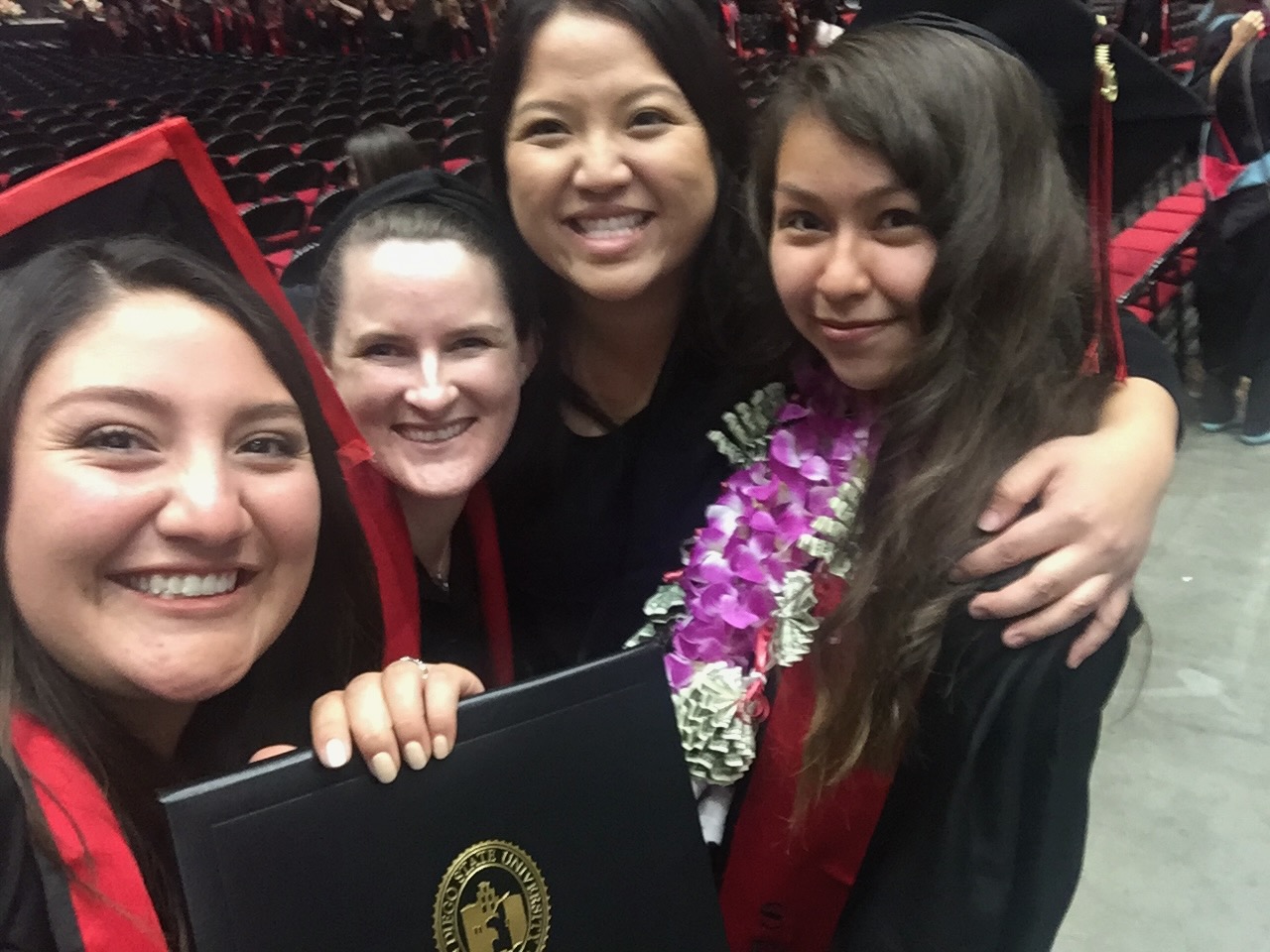
Commencement day with students from my caseload, the outcome the Progress Report process was built toward.
// Case Study: Service Design · Process Redesign · Higher Education · 2017–2021
A warning email tells a struggling student they're in trouble. It doesn't teach them what to do differently, and nobody was checking whether they did. I redesigned academic probation intervention at SDSU end to end, from how the data reached me to what accountability looked like once a student was "helped."
Commencement day with students from my caseload, the outcome the Progress Report process was built toward.
01. Project at a Glance
Role
Lead Academic Advisor & Lecturer, San Diego State University (2017–2021)
My Role in This Project
Sole designer and owner: identified the problem, built the data process, designed the intervention, and ran it independently within a 600-student caseload
Tools / Systems
Google Workspace, Streak (Gmail mail-merge), institutional reporting via SDSU's data administrator
Outcome
Roughly 92% of students who completed the process returned to good standing within one academic year (my best estimate; see Outcome section)
Recognition
Outstanding Advisor of the Year, 2019, selected from roughly 200 professional staff and faculty advisors
02. Overview
Each term, SDSU flagged students who earned a D, F, or W grade, or who were continuing on academic probation (below a 2.0 GPA), through an institutional DFW report. The process for reaching these students, arguably the most vulnerable population in my 600-student caseload, was reactive, siloed, and untracked.
I redesigned it end-to-end: how the data reached me, how outreach happened, and what accountability looked like once a student was "helped." I was also tracking a second, related threshold on top of academic probation: Liberal Studies' own impaction requirement of a 2.7 GPA, the university-mandated bar every SDSU major sets for a student to move from pre-major into the major. A student could clear academic probation (above 2.0) and still be below the 2.7 needed to formally declare Liberal Studies, so I watched both, sometimes for a full year.
The result was a structured intervention, the Progress Report process, that I estimate helped roughly 92% of students who completed it return to good academic standing within one academic year.
03. The Problem
Before this process existed
What I redesigned in the message itself
The institutional email was generic and impersonal: a blanket notice with no explanation of why. I rebuilt it around specific, personal detail rather than a form-letter warning:
If a student didn't open it within 3–5 days, I followed up with another email, a phone call, and a text: a deliberate choice not to let one unopened warning be the end of the outreach.
04. Research & Discovery
I'd done similar work before, at Cal State East Bay, where the university already had EAB: I could pull DFW data directly and run advising campaigns through it. SDSU hadn't adopted EAB yet when I started, so I had to rebuild that capability manually.
Direct data access
Requested direct access to institutional data from SDSU's data administrator, rather than relying on the Assistant Dean's report and timeline. Had a custom report built that went beyond the standard DFW list, including GPA data, so I could see who was below the separate 2.7 impaction threshold too, not just who was flagged for probation.
Speed & tracking
Ran the report myself as soon as grades posted, so outreach could begin immediately rather than waiting on someone else's distribution schedule. Used Streak, a Gmail mail-merge add-on, to send personalized outreach at scale and track opens and responses: a manual substitute for the campaign tracking EAB would have handled natively.
A second research channel
I was also co-teaching the department's senior capstone seminar. Being in the classroom, not just reading a transcript after the fact, gave me a qualitative layer the institutional report couldn't provide: I could directly observe engagement, participation, and disengagement, then feed that back into how I supported students as their advisor. Two research channels into the same population, quantitative (grades, GPA) and observational (classroom behavior), triangulated to build a fuller picture of who needed intervention and why.
The DFW report tracker I built and ran myself, custom-pulled to include GPA data beyond the standard probation list. Sample shown with fabricated data for illustration.
05. The Design: The Progress Report Process
The most common trigger for using it: a student would tell me they were struggling in a class, and when I asked "have you talked to your professor?", the answer was almost always no. The Progress Report was my answer to that gap: a mechanism that made the office-hours conversation happen, instead of just recommending it.
01
A defined escalation ladder, not a single warning
Students were held to a professional-etiquette standard: respond within two to three business days, the same expectation I'd hold them to in any professional setting. If they didn't respond: a follow-up email on the same thread, a phone call, another email copying the Assistant Dean (which reliably prompted a response), and only as a last resort, direct hand-off to the Assistant Dean, something that happened maybe two or three times a term, out of the full flagged population.
Michelle Xiong
to Sam Garcia <sam.garcia@example.edu>
cc COE Assistant Dean
Following up — let's find a time this week
Hi Sam,
I have not received a reply from you. I'm following up and would like to set up a phone appointment or in-person appointment to discuss your grades from last semester. My availability this week is Monday and Wednesday, 10 AM–12 PM and 3 PM–5 PM. If none of these times work for you, I can look at the following week.
Please know that you are not in trouble. As your advisor, I would like to help provide you with options and resources for this semester.
I look forward to hearing from you soon.
Best,
Michelle
Liberal Studies Advisor
SDSU College of Education
A follow-up email after no response, with the Assistant Dean copied — the visible escalation step that reliably prompted a reply.
02
A required in-person meeting, reframed from discipline to support
The message was explicitly "you're not in trouble, I'm here to help," followed by building an academic plan together. As a mandated reporter, I told students early in the conversation that certain disclosures would require me to report them, so they could decide what and how to share without being caught off guard later, a trust-building design choice, not just a compliance requirement.
03
The Progress Report itself
A structured form requiring the student to meet with each current-term instructor, normalizing office hours and creating faculty-verified accountability. More on the design decisions behind the form below.
04
Faculty sign-off
Instructors confirmed the meeting happened and noted positives and concerns, with an explicit invitation to email me directly, closing a communication gap that didn't exist in the old model.
05
A closing-the-loop meeting, followed by recurring check-ins
The student returned the completed report, we discussed it together and built a concrete plan based on what instructors had flagged. From there, I set up a recurring monthly advising appointment for the rest of the term: a standing check-in for progress, support, or referrals. The relationship didn't end once the form was turned in.
The Progress Report form I designed, coded for fast faculty feedback.
A structured form requiring the student to meet with each current-term instructor, normalizing office hours and creating faculty-verified accountability.
Why students weren't going
Answers clustered around two things: they didn't think it was necessary, or it conflicted with their schedule. Many were non-traditional, working while enrolled, and assumed office hours were fixed and non-negotiable. Part of the conversation was walking them through the fact that they could ask a professor to meet outside posted hours.
How the form is structured
Every course the student was enrolled in that term, with a row per course for the instructor to sign, date, and rate.
The coded rubric
Rather than open-ended comments, a 1–5 performance rating (Excellent through Failing) paired with lettered sub-codes for fast, specific feedback:
A short letter to the professor explained why I was asking for their time, and routed everything back to me by name and email.
06. Beyond the Form: Edge Cases and Warm Handoffs
Not every student's problem was solvable with an office-hours visit. The underlying design principle (meet the student where they are, then connect them to the right resource personally rather than just pointing) extended to several recurring edge cases.
Students unaware of their own options
Many didn't know they could take a late withdrawal from an entire term, or that they had a limited "bank" of course forgiveness credits (16 over their academic career) to spend carefully. Part of my role was translating opaque policy into a real decision: what a withdrawal protects, what it costs, what a course repeat does instead.
Petitions requiring documentation
For students facing a crisis (e.g., a parent's death), I helped them identify what documentation would actually satisfy a petition, often something as simple as a funeral program, and connected them directly with the Assistant Dean to move the appeal forward.
Financial aid implications
Because many students were on Pell Grants or other aid tied to enrollment status, withdrawals or leaves of absence had downstream financial consequences. Rather than telling students to "go talk to financial aid," I built relationships with financial aid counselors and made warm introductions.
Leave of absence, underused
Students often didn't realize they could take up to three consecutive leaves of absence, which reframed some situations from "drop out" to "pause and return."
The common thread: a warm handoff (a real person, an email introduction, walking a student to the tutoring center in person) increased follow-through compared to a cold referral. Students didn't need more information, they needed support with the follow-through action itself. It wasn't unusual for the last 15 minutes of a one-hour appointment to be spent physically walking a student to the tutoring center and handing them off to someone there, rather than just telling them where it was.
07. An Unplanned Effect
The Progress Report was designed to solve a student-side problem: getting students comfortable walking into office hours. But it ended up solving a faculty-side problem I hadn't explicitly set out to fix.
Before this process, faculty were largely reactive by default: in a busy academic environment split between teaching and research, professors typically only learned a student was struggling after the fact. There was no mechanism for an advisor's knowledge (a student's probation history, a pattern across semesters) to reach the instructor before that point.
The form changed that. It gave faculty a reason to engage a student proactively, and gave students a built-in, low-pressure script for approaching a professor they didn't know how to talk to. It wasn't the student inventing a reason to show up; it was "my advisor is requiring this," which took the social risk out of an already intimidating interaction.
"One faculty member, after encountering the form, started proactively emailing me whenever they were concerned about a student, without waiting for a Progress Report to prompt it."
That wasn't something I built or requested; it emerged because the form had made the advisor-faculty relationship visible and functional in a way it hadn't been before. Students also generally weren't surprised or upset by this arrangement: it read as a support network working together, not surveillance behind their back.
The advisor sits at the center, keeping student, faculty, and administration visible to each other, rather than isolated updates that never connect.
08. Outcome
~92%
Of students who completed the Progress Report process returned to good academic standing within one academic year, my best estimate at the time, not a figure I can pull from institutional records today.
30–40
Students fell into the probation/DFW population each term, out of my 600-student caseload. Of those, typically only 4–10 never responded to outreach at all.
0 → ~all
Office-hours adoption among flagged students, before and after. Before, essentially zero went. Because the Progress Report made a faculty-signed visit a requirement, adoption went to effectively everyone on the list completing it.
I want to be upfront about what the 92% figure can and can't tell you: I don't have a clean way to isolate how much of this outcome was the intervention itself versus other factors: a particular cohort's circumstances, a stronger semester overall, or students who would have recovered regardless of outreach. I no longer have access to the original data, so I'm stating this as an approximation rather than a verified statistic.
What I can say with confidence is the structural change: before this process, there was no tracking of outcomes at all, so even an imperfect estimate is more than existed previously. I'd frame the real evidence of impact as the process itself (closed-loop, faculty-verified, multi-touchpoint) rather than treat the percentage as a rigorously isolated result. The office-hours adoption number is the one I can actually stand behind, and it's the mechanism the rest of the outcome depends on.
The structural shift
The old process ended at notification. This one didn't end until the student, their instructors, and I had all been in the loop, and a plan existed.
Mapping the process, before and after
The process I inherited, and the process I built to replace it.
Broader context: Liberal Studies sits within SDSU's College of Education, and campus-wide data shows the college posting some of the strongest gains on campus across this general period (2012–2023), including a 22.9-point rise in 4-year freshman graduation rate and the lowest Pell-eligible equity gap on campus. These are multi-year, college-wide figures I can't isolate my own contribution within; I include them as context for the environment my work was part of, not as a metric I can claim credit for.
09. A Moment That Shows the "Why"
A student from my caseload, and the moment that changed how I designed this process.
One student, normally engaged and high-performing, failed nearly all her courses in a term and landed on academic probation. She stopped responding to outreach entirely: emails (which I could see she'd opened), calls, even texts. I eventually ran into her on campus, and she visibly tried to avoid me.
When I caught up with her, she said she'd been avoiding me out of shame, afraid she'd let me down and would "get in trouble." Once she understood that wasn't the case, she opened up about a family crisis (her mother's illness) that had derailed her semester. That conversation led to a late petition that reclassified her failing grades as withdrawals, protecting her GPA and getting her off probation.
This moment is the clearest evidence for why the Progress Report leads with "you're not in trouble" rather than a warning: shame and fear of consequence were actively preventing a struggling student from seeking help. Design that assumes students will self-advocate when scared is design that fails exactly the students who need it most.
10. Reflection
Amanda was one of the most active, event-attending students in the program, and her response to failing wasn't to ask for help, it was to hide. A process that starts with a warning email confirms the fear a student already has, that they're in trouble, which pushes exactly the students who need help furthest away. Leading with "you're not in trouble, I'm here to help" wasn't a soft touch; it was a deliberate design decision to remove the barrier that was actually stopping students from engaging.
The Progress Report didn't become permanent, institutionalized infrastructure. It continued to be used within the department after I left in 2021, but it was eventually replaced, not abandoned outright, when the college built a dedicated "care team" of specialized advisors running on EAB Navigate, which SDSU adopted after my time there.
I'd read that less as my design failing to stick, and more as a resource-constrained solution that held the line until the institution could invest in a proper systemic replacement, which is, in a way, the best outcome a manual workaround can hope for.
Keep exploring

Rebuilt advising infrastructure end to end for a 600-student caseload
Three years of data and student stories that changed institutional policy

Designed and launched a small business marketplace end to end